What are the rules of darts and how do you play 501?
05/05/2026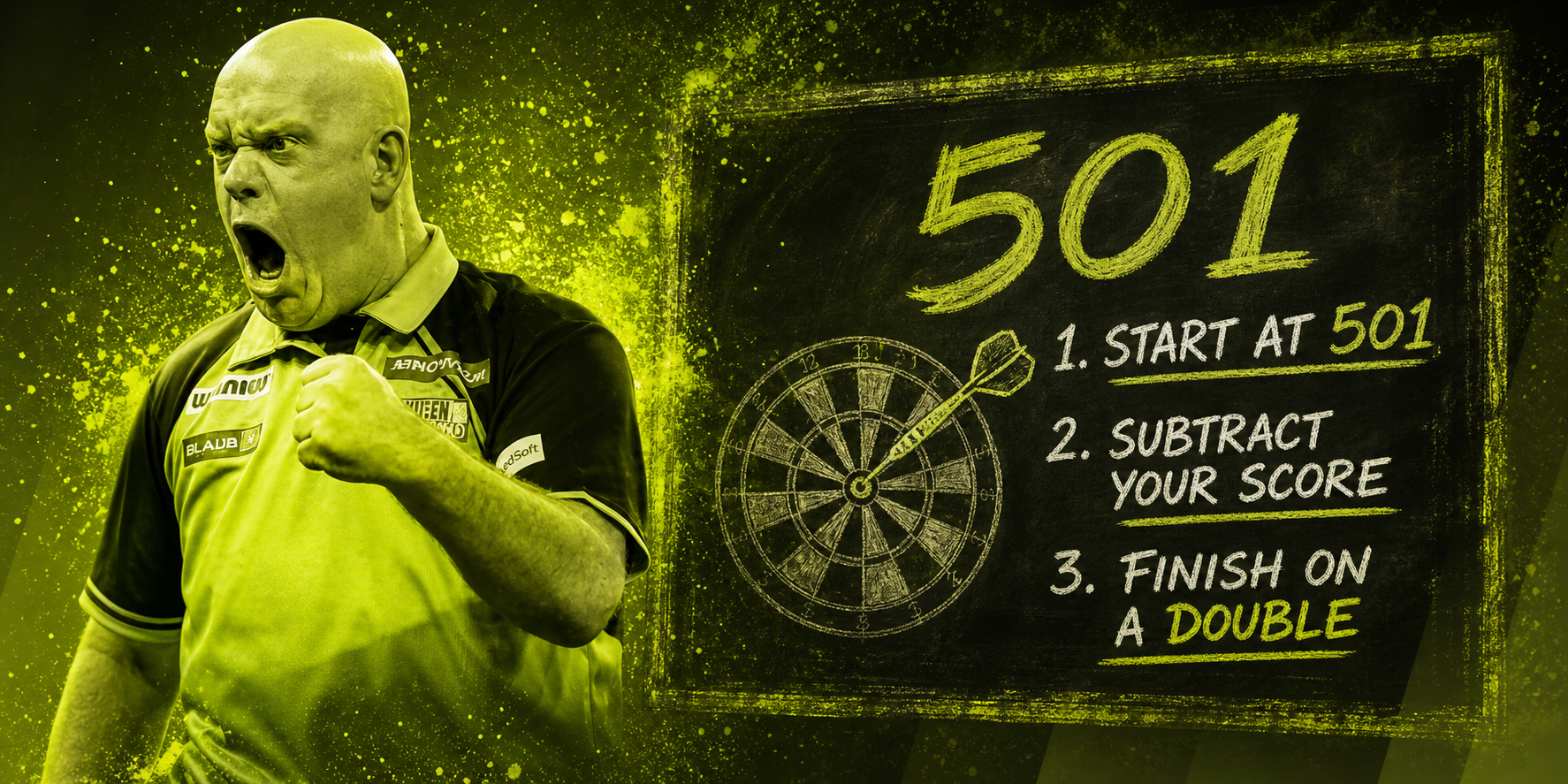

Shortest answer: In darts, players take turns throwing three darts at the dartboard, subtracting their score from 501. The first player to reach exactly zero with their final dart in a double or the bullseye wins the leg. The board hangs at 1.73 m and the throwing line is at 2.37 m (official PDC measurements).
Darts is technically simple: three darts per visit, subtract your score, finish on a double. It gets interesting once you approach zero. This article first covers the basic rules and then goes deeper into 501 — the format used in every PDC tournament.
These rules come from the PDC and WDF and apply to both professional and recreational play. Local leagues and pubs sometimes use their own variations, but the rules below are the standard.
What are the basic rules of darts?
Two players take turns throwing three darts at the board. Each turn is called a visit. The total of the three darts is subtracted from the starting total (usually 501). The first player to reach zero with a double as their final dart wins the leg.
The official setup is defined by the PDC: the centre of the bullseye sits at 1.73 m from the floor, with the throwing line (oche) at 2.37 m horizontally from the board. Soft tip darts are played from 2.44 m.
How is the board divided and how do you score?
The board has 20 numbered segments plus a bullseye in the middle. The values are:
• Single (the main segment): face value, e.g. 20 points for the 20.
• Double (the narrow outer ring): twice the value, so double 20 = 40 points.
• Triple (the narrow inner ring): three times the value, so triple 20 = 60 points.
• Outer bull (the green ring around the centre): 25 points.
• Bullseye (the red centre): 50 points and counts as a double.
The maximum score in one visit is 180: three triple 20s. Darts that miss the scoring area or fall out of the board score nothing.
What is a leg, a set and a match?
A leg is one game of 501. A set consists of a fixed number of legs (often best of 5 legs). A match is won by being the first to reach a set number of legs or sets, depending on the tournament format.
The Premier League Darts plays leg format (best of 11), while the PDC World Championship uses set format. A player who wins the first leg of an opponent's throw in set format scores a break.
How does 501 darts work exactly?
Both players start at 501 points. Each visit allows three darts. The score for the visit is subtracted from the remaining total. The objective is to reach exactly zero first, with the winning dart landing in a double or the bullseye.
Important: in the standard variation, scoring counts from your very first dart — no need to "double in". Only the PDC World Grand Prix uses double-in, where scoring begins only after a double has been hit.
What does double-out mean?
The winning dart must land in a double segment or the bullseye. That's called double-out. With 40 left, double 20 finishes the leg. With 50 left, the bullseye works (50 points, counts as a double) or for example 18 + double 16.
The lowest possible finish is double 1 (2 points). The highest three-dart finish is 170: triple 20 + triple 20 + bullseye — known as the "Big Fish".
When do you bust?
You bust if your visit takes you below zero, lands you on exactly 1, or finishes on zero without a double as your last dart. A bust voids the entire visit and your score returns to where it stood before the visit.
Example: you're on 32 and throw single 20, leaving 12. Your second dart hits single 15 — that would put you on −3. Bust. Your score reverts to 32 for your next visit.
What are bogey numbers?
Bogey numbers are scores you cannot finish in three darts, even with a perfect visit. There are seven of them: 169, 168, 166, 165, 163, 162 and 159. If you land on one, you must first set up a more useful number in the current visit and finish on the next visit.
Tactical players actively avoid bogey numbers. From 186, hitting single 20 leaves you on 166 (a bogey). Triple 19 is the smarter choice: it leaves 129, a standard three-dart finish.
What is a nine-darter?
A nine-darter is the minimum number of darts needed to finish 501. It's considered the perfect leg, the equivalent of a hole-in-one in golf. The most common combination is 180 + 180 + 141 (triple 20, triple 19, double 12).
On the PDC tour, around 10 to 15 nine-darters are thrown per season across all official events. Phil Taylor holds the career record.
Which 501 finishes should you memorise?
The finishes below are the most common routes to zero. Players who know these by heart spend less time calculating mid-game and can focus on their throwing technique.
Remaining | Recommended finish | Notes |
170 | T20 – T20 – Bull | The "Big Fish". The highest possible three-dart finish. |
167 | T20 – T19 – Bull | Classic high finish, often used by professionals. |
161 | T20 – T17 – Bull | Ends on the bullseye, which counts as a double. |
160 | T20 – T20 – D20 | Three twenties in a vertical line. |
141 | T20 – T19 – D12 | The finish of the most common nine-darter (180 + 180 + 141). |
140 | T20 – T20 – D10 | One of the most-practiced finishes. |
121 | T20 – T11 – D14 | Standard route. Missing the T11 often still leaves a bull finish. |
120 | T20 – S20 – D20 | The Shanghai finish. Hits all three sections of the 20. |
100 | T20 – D20 | Two darts. Standard route. |
81 | T19 – D12 | Two darts. |
60 | S20 – D20 | Two darts. |
40 | D20 | One dart. The most-practiced double. |
32 | D16 | One dart. Many players deliberately leave 32, missing leaves you on 16. |
2 | D1 | One dart. The lowest possible finish. |
A complete checkout chart from 170 down to 2 hangs on the wall in virtually every darts venue. Most beginners learn the finishes under 100 first and build from there.
Which darts and dartboard do you need for 501?
For 501 on a steel tip board you need three things: a sisal board (the PDC standard), a set of steel tip darts between 20 and 26 grams, and a properly measured oche at 2.37 m.
Brass darts are a fine starting point for beginners, but tungsten darts at 80% or above stay sharper longer and group more tightly because the barrel is slimmer. A Winmau Blade 6 or a KOTO King Pro 360 is a popular sisal board choice.
Frequently asked questions about the rules of darts and 501
related blogs
Best beginner darts in 2026
What dart flight shapes exist and what do they do?
How do you hang a dartboard? Official height, distance and step-by-step guide


