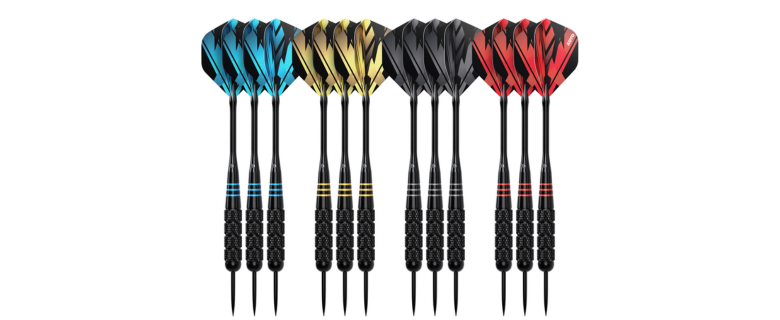
Short answer: The main dart accessories are flights, shafts, dart points, dart cases and tools like a dart sharpener, repointing machine and dartboard leveller. Flights and shafts are wear parts that affect how the dart flies. Tools extend the lifespan of your darts and improve your setup.
Beyond the dart itself, a wide range of accessories shapes your playing experience and setup. Some parts, such as flights and shafts, are replaced regularly. Others, such as a dartboard leveller or dart case, are bought once.
Below is an overview of the main categories, what each accessory does and when you use it.
Flights stabilise the dart in the air. There are four basic shapes: Standard, Kite, Pear and Slim. The Standard has the largest surface area and provides the most lift; the Slim has the smallest and suits faster throws or players who want to tighten their grouping.
Flights also vary in thickness, measured in micron. Common values are 75, 100, 125, 130 and 150 micron. Thicker flights last longer but add a small amount of weight to the total dart.
L-Style flights are sturdier flights that hold their shape better and are often used without a flight protector. Integrated flight systems combine flight and shaft into a single component, so flights cannot work loose.
A flight protector is a small clip placed at the back of the flight that prevents damage when darts collide. With paper flights it noticeably extends lifespan. With L-Style and integrated systems a protector is usually unnecessary.
A flight lock punch presses a small ring into the shaft so the flight sits more firmly. This stops flights from coming loose during play. It is a one-off treatment per shaft.
Shafts connect the flight to the barrel. Together with the flight they determine the balance and flight characteristics of the dart. The most common material is nylon: affordable, forgiving and available in many colours. Aluminium and titanium shafts last longer but are heavier and may snap off inside the barrel.
Standard lengths are X-short, Short, Inbetween and Medium. A shorter shaft moves the centre of mass forward, a longer shaft moves it back. The right length depends on your throw and the balance of your barrel.
Steel tip dart points become blunt and smooth with use, reducing grip in the sisal fibres of the board. The result: bounce-outs. A dart sharpener (small sharpening stone) roughens the point lightly and restores grip immediately.
A repointing machine removes worn points and installs new ones in the same barrel. Useful when points are truly spent, or when you want to experiment with different point lengths (for example 32 mm instead of 36 mm).
Quick points are dart points with a threaded fitting that you can change without a machine. This lets you switch between point lengths or replace a worn point without tools. They work only with compatible barrels.
A dart case protects your darts during transport and keeps extra flights, shafts and points together. Small cases hold one set plus accessories and fit in an inside pocket. Larger models hold multiple sets and are popular with players who play on location.
Around the dartboard you will find several tools that complete your setup.
A dartboard leveller is a spirit level used to hang the board perfectly straight. A tilted board affects your grouping and means you train on a flawed reference point. Hanging it correctly once prevents years of frustration.
A surround catches misses and protects the wall around the board. Good dartboard lighting eliminates shadows on the board, which is essential for consistent throwing. For detail see the blog on dartboard surrounds and the blog on dartboard lighting.